

What Is a Centralized Exchange?
A plain-language explainer on how centralized crypto exchanges work, who holds your funds, how they differ from a DEX, and what to check before you sign up.
By GN Media
A centralized exchange, usually shortened to CEX, is a company that runs a platform for buying, selling, and trading cryptocurrency. It matches buyers with sellers on an order book, and it holds custody of the funds in each account, similar to how a bank holds the money in your checking account.
Most people's first crypto trade happens on a centralized exchange, because it looks and works like any other trading app: sign up, verify your identity, deposit funds, and place an order. This guide breaks down what's actually happening behind that simple interface.
Quick summary
In this guide, you will learn:
How a trade actually moves through a centralized exchange.
What custody means and why it matters.
How a CEX differs from a decentralized exchange (DEX).
The features most centralized exchanges share.
The risks worth understanding before you deposit.
What to check before choosing one.
How a trade moves through a centralized exchange
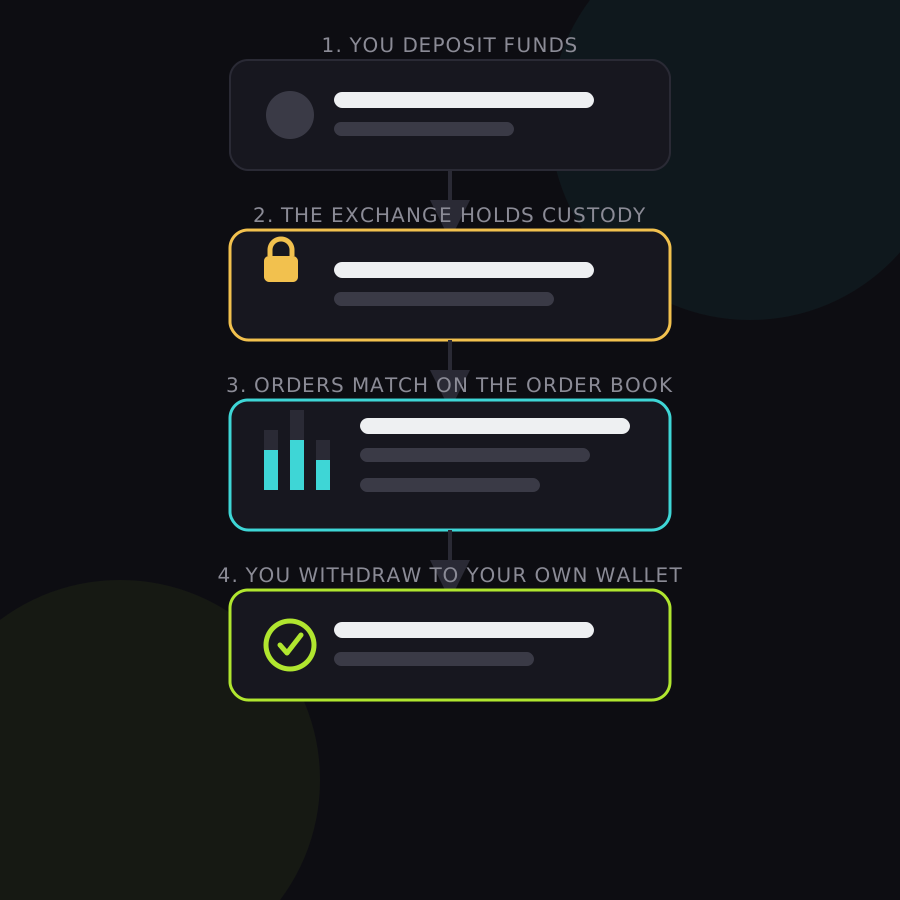
When you deposit crypto or cash onto a centralized exchange, it moves into the exchange's own wallets, not a wallet only you control. Your account balance is really an entry in the exchange's internal ledger.
When you place a buy or sell order, the exchange's matching engine looks for a compatible order from another user and pairs them, the same basic mechanism a stock exchange uses. Because the exchange already holds both sides' funds, it can settle the trade instantly by updating both ledger entries, instead of waiting for a blockchain confirmation.
Only when you withdraw does the exchange actually broadcast an on-chain transaction, sending crypto from its wallets to the wallet address you provide.
Custody: who actually holds your crypto
"Not your keys, not your coins" is the shorthand crypto users repeat for a reason. On a centralized exchange, the exchange holds the private keys to the wallets your funds sit in. You have a claim on that balance through your account, but you don't control the keys directly.
That trade-off is what makes a CEX convenient: password resets, customer support, and instant trades are all possible because the exchange controls the funds on your behalf. It's also the trade-off behind every major exchange collapse and hack in crypto history. Custody is convenience borrowed against trust in the operator.
CEX vs. DEX
A decentralized exchange (DEX) runs on smart contracts instead of a company's servers. Trades settle directly from your own wallet, so you keep custody of your funds the entire time, but you're also responsible for your own keys, gas fees, and mistakes.
Custody: a CEX holds your funds; a DEX never takes custody.
Identity: a CEX typically requires ID verification (KYC); most DEXs don't ask for one.
Speed and fees: a CEX settles trades instantly off-chain; a DEX settles on-chain, so speed and cost depend on network conditions.
Recovery: a CEX can often reverse an error or help with a lost password; a DEX transaction is final and support has no way to undo it.
Asset selection: a CEX lists assets after its own review; a DEX generally lets any token trade, including unvetted ones.
Common features on a centralized exchange
Spot trading — buying and selling crypto at the current market price.
Futures or margin trading — trading with leverage, which multiplies both gains and losses.
Fiat on-ramps — depositing or withdrawing regular currency by bank transfer or card.
Staking or earn products — locking up crypto on the exchange to earn a yield.
A built-in custodial wallet — for holding balances between trades without moving them elsewhere.
Risks worth understanding
Custody risk — if the exchange is hacked, mismanages funds, or becomes insolvent, your balance can be affected even though you did nothing wrong.
Withdrawal limits and freezes — an exchange can pause withdrawals during technical issues, security incidents, or regulatory action.
Regulatory risk — rules for exchanges vary by country and change over time, which can affect which features or assets are available to you.
Account security — anyone who gains access to your login can access your funds directly, since the exchange itself is a single point of failure.
What to check before you choose one
Where the exchange is licensed or registered, and whether it operates legally in your country.
Whether it publishes proof of reserves or a similar audit of the funds it holds.
Its history with hacks or outages, and how it responded.
Whether it offers two-factor authentication (2FA) and other account security controls, and turn them on immediately after signing up.
Its fee schedule for trading, deposits, and withdrawals, since these vary widely between exchanges.
This guide is educational and doesn't recommend a specific exchange. Cryptocurrency trading involves substantial risk, and funds held on any exchange are only as safe as that exchange's security and solvency. Review an exchange's own terms and security practices before depositing funds.